
Our Blog
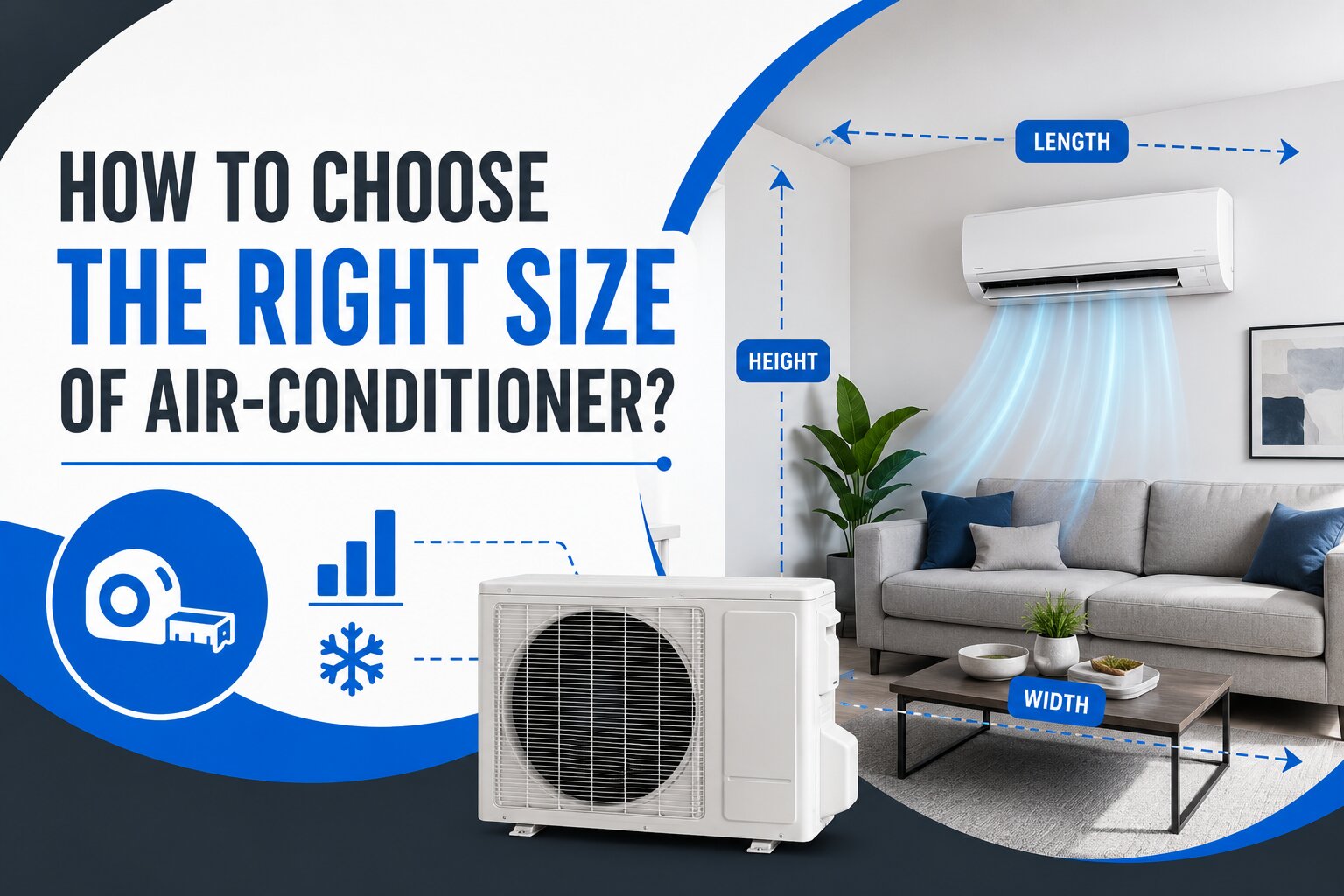
How to Choose the Right Size of Air-conditioner
We’ve all been there. The summer heatwave hits, the bedroom feels like an oven, and you decide it’s finally time to invest in air conditioning. The temptation is to jump online and buy the biggest, most powerful unit you can afford, assuming it will cool the space in seconds.
Bigger isn’t always better when it comes to climate control. In fact, installing an oversized system can cause just as many headaches as fitting one that’s too small.
Figuring out exactly how to choose the right size of air-conditioner for your room or property might seem like a dark art reserved for engineers. But once you understand a few basic principles, it makes total sense. We are going to walk you through a simple method to estimate your requirements, explain why getting the capacity spot-on matters, and show you when it’s best to call in the professionals.
What “size” actually means – Kilowatts (kW) vs British Thermal Units (BTU)
When professionals talk about the “size” of an air conditioning system, we aren’t talking about the physical dimensions of the plastic box on your wall. We mean its cooling (and heating) capacity.
In the UK and Europe, we generally measure this capacity in kilowatts (kW). You will also see systems rated in British Thermal Units (BTU). There is no need to get bogged down in the maths. BTU is simply another way of expressing capacity. As a rough guide, 1 kW is equal to roughly 3,400 BTU. So, a standard 3.5 kW unit is broadly equivalent to a 12,000 BTU system.
Manufacturers rate their systems based on ideal conditions, but real-world performance depends entirely on your specific room.
Why getting the correct size air conditioning unit matters more than people think
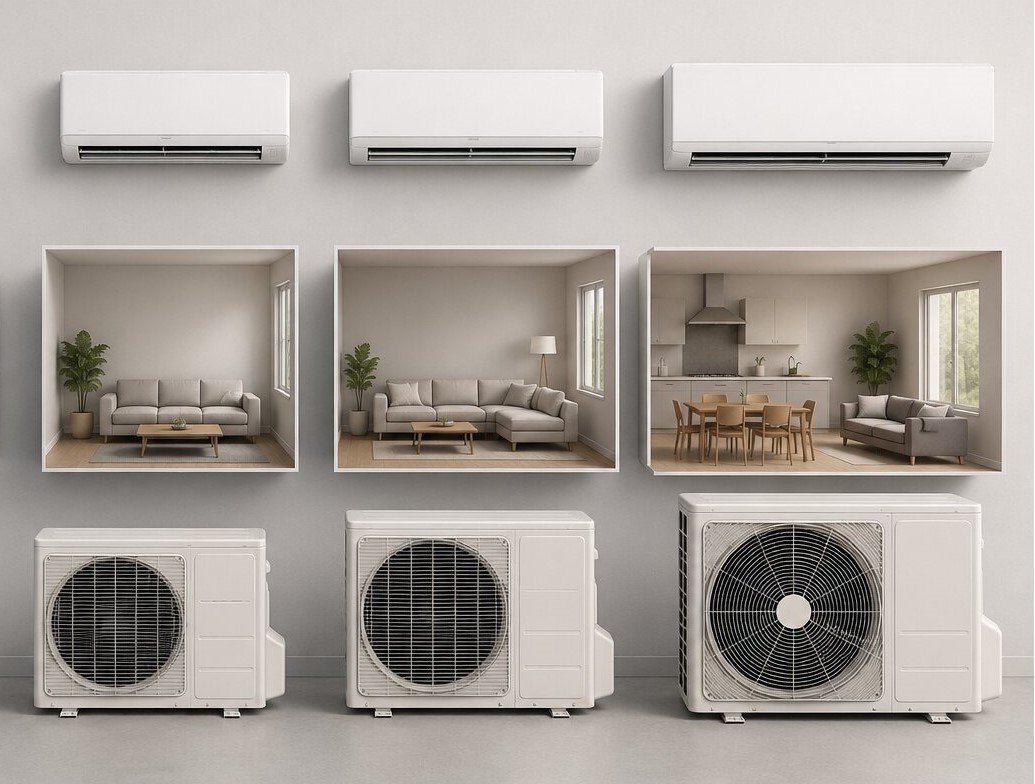
You might assume a massive air conditioner will simply cool your room faster and then switch off. Sadly, the physics of climate control disagree.
Finding the correct size air conditioning unit is a delicate balancing act. If your system is too powerful for the space, it will “short cycle”. This means it blasts freezing air, hits the target temperature in minutes, and shuts down before it has a chance to dehumidify the room. The result is a clammy, uncomfortable space. It is a bit like wearing a heavy winter coat in August, getting instantly sweaty, and taking it off every two minutes.
On the flip side, an undersized unit will run constantly, desperately trying to reach a temperature it lacks the muscle to achieve. It will burn through electricity, drive up your bills, and wear out its internal components far sooner than it should.
A quick air conditioner size calculator
If you want a rough idea of the capacity you need before speaking to an installer, you can use a basic rule of thumb. While it isn’t a substitute for a professional survey, this air con size calculator UK method gives you a solid starting point.
First, measure the length and width of your room in metres. Multiply them together to find the floor area in square metres.
Next, multiply that floor area by a base capacity factor. For a standard UK bedroom or living room with normal ceiling heights and average insulation, multiply the area by 0.1 kW. If you are sizing a kitchen, a south-facing room, or a space with lots of electronics, multiply by 0.15 kW instead.
A quick worked example:
Let’s say you have a standard bedroom measuring 4m by 3m.
4m x 3m = 12 square metres.
12 sqm x 0.1 kW = 1.2 kW.
In the real world, domestic wall units generally start at around 2.0 kW, so a small entry-level system would comfortably handle this bedroom.
Typical room-to-unit sizing examples
To make things even simpler, we have put together an indicative guide for typical UK homes and small commercial spaces.
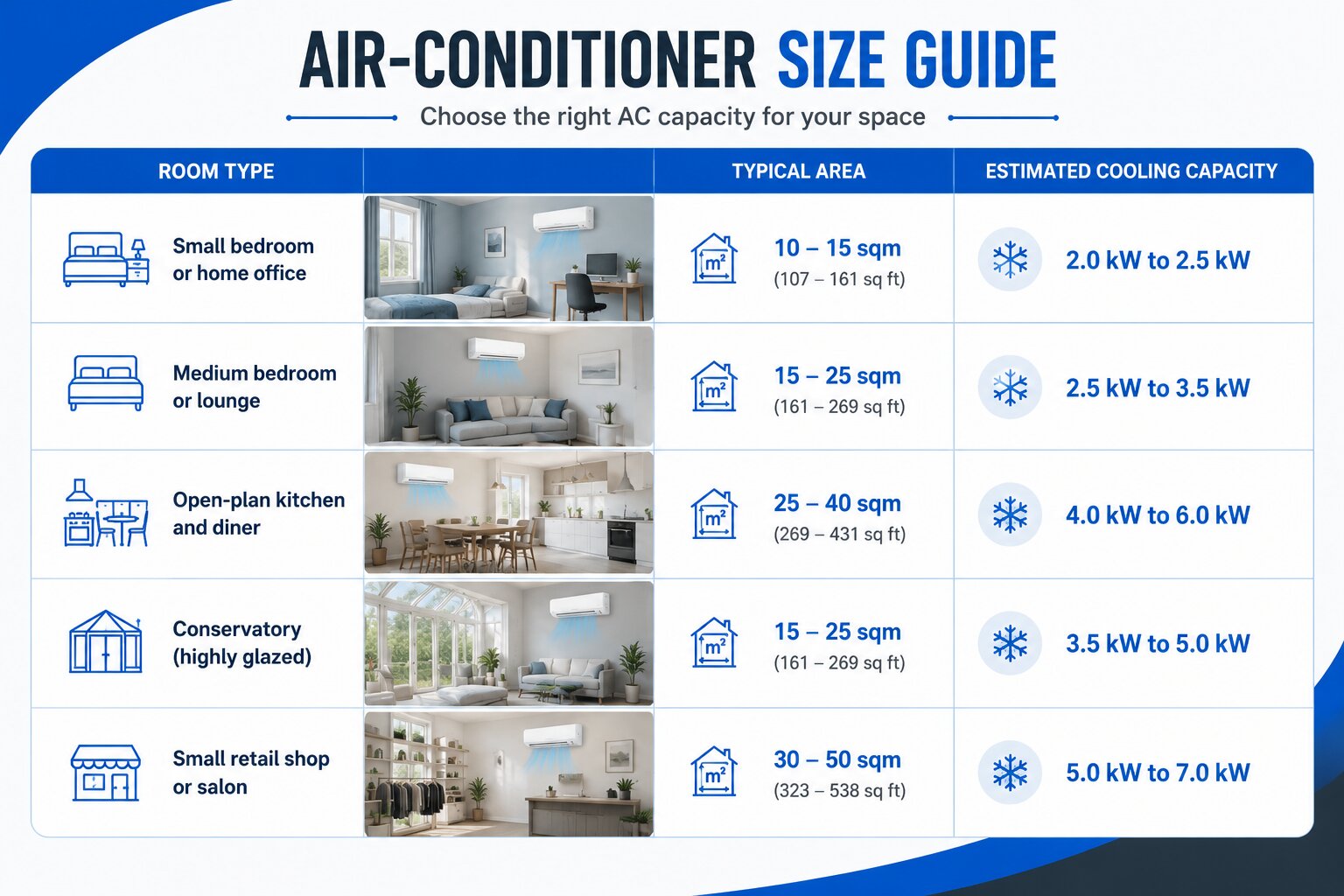
Keep in mind that these are just starting ranges. Your final requirement will depend heavily on the layout and heat gains of the specific space.
Don’t forget these hidden factors
Square metre calculations are helpful, but they only tell half the story. Several hidden factors will influence the final specification of your system.
Ceiling height
High ceilings mean a larger volume of air to cool, requiring more capacity.
Glazing and sun exposure
A south-facing room with large bifold doors acts like a greenhouse. It will need significantly more cooling power than a shaded north-facing room.
Occupancy levels
A busy hair salon with five stylists and waiting customers generates far more body heat than a quiet home office.
Equipment loads
Computers, servers, kitchen appliances, and even lighting all kick out heat that your air conditioner needs to overcome.
Insulation
Modern, highly insulated homes hold onto heat stubbornly.
Noise sensitivity
Bedrooms require whisper-quiet systems (ideally under 25 decibels). Sometimes, selecting a slightly larger unit allows it to run on a lower, quieter fan speed while still moving plenty of air.
One unit or multi-split? Choosing the right set-up
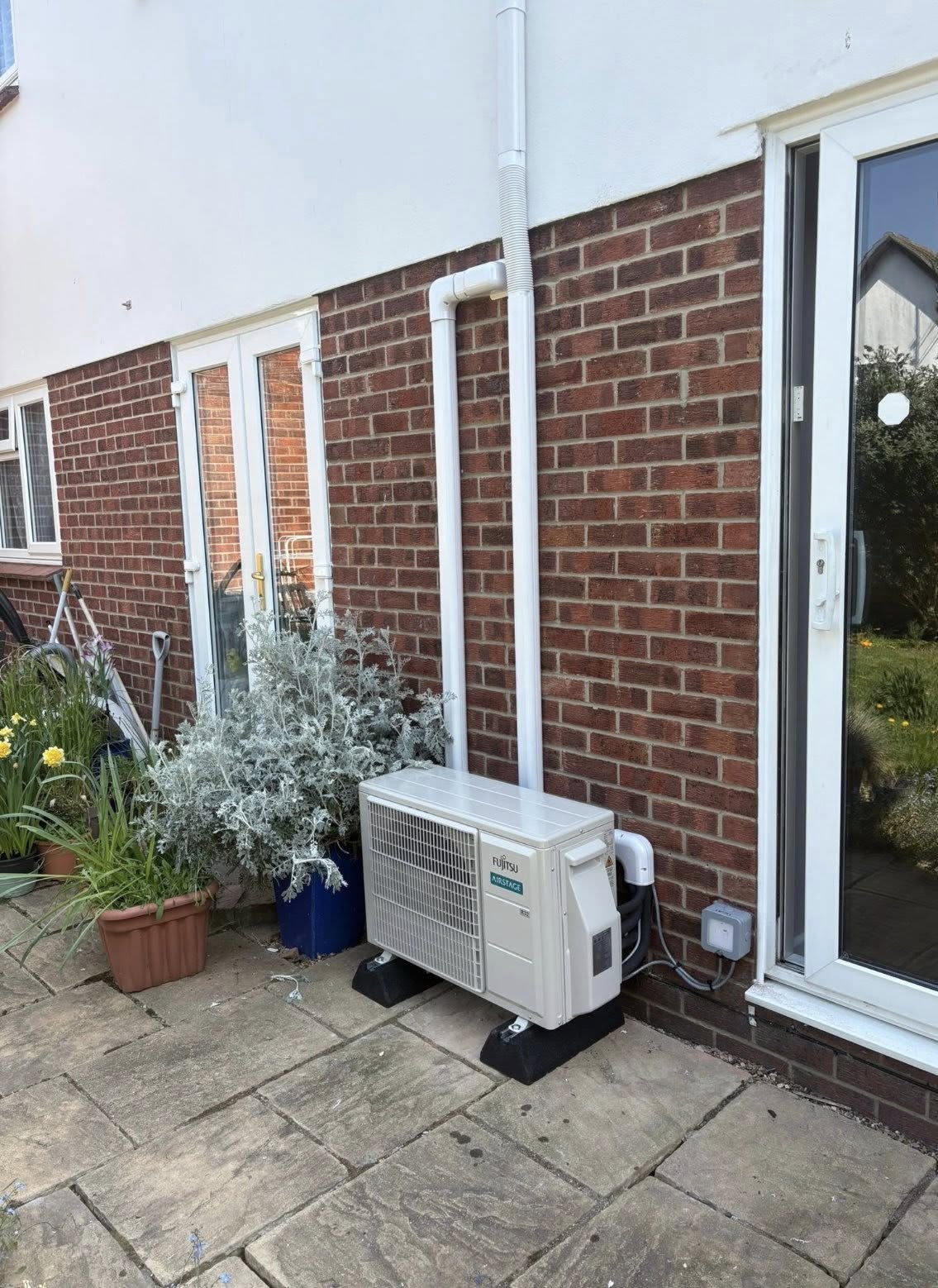
If you only want to cool a single room, a standard “single split” system does the job perfectly. This consists of one indoor unit connected to one outdoor box.
Things get slightly more complex if you want to climate-control several rooms. Instead of plastering your exterior walls with multiple outdoor boxes, we usually recommend a multi-split system. This allows a single, suitably sized outdoor unit to run multiple indoor wall-mounted or ceiling-mounted units.
For a completely seamless aesthetic, we can also design ducted solutions that hide the machinery in your ceiling void, leaving only subtle grilles visible.
Common sizing mistakes to avoid
When it comes to getting the right size air conditioner, we see the same pitfalls time and time again.
The most frequent mistake is ignoring the impact of glass. People often buy an air conditioner based strictly on the floor area of their conservatory, completely forgetting that a glass roof traps intense solar heat. Another common error is assuming a cheap portable air conditioner’s claimed capacity will perform exactly like a fixed, professionally installed wall unit. Portable units are notoriously inefficient and struggle to vent heat properly.
Finally, many buyers fail to plan for the future. That spare bedroom might become a home gym next year, drastically changing its cooling requirements.
When to get a professional air conditioning survey
You can certainly estimate your room size needs using the maths above, but getting a professional survey gives you absolute peace of mind. We strongly recommend booking a site visit if you have open-plan spaces, loft conversions, heavy glazing, or a commercial property with high footfall.
Our F-Gas qualified engineers at Christy Cooling Services know exactly how to assess heat loads, pipework runs, and drainage requirements. We cover the entirety of Essex and London, and we are more than happy to pop out, measure up, and provide a comprehensive, free quote to ensure you get the right air conditioner size.
Frequently asked questions
What size air conditioner do I need for a bedroom in the UK?
For most standard UK bedrooms, a 2.0 kW or 2.5 kW system is more than sufficient. The key priority for a bedroom is actually the noise level, so look for a unit that operates at 25 decibels or lower on its quiet setting.
What happens if my air conditioner is too powerful?
An oversized unit will cool the room too rapidly and switch off before it can remove humidity from the air. This causes a damp, clammy feeling and increases the wear and tear on the system’s compressor due to constant starting and stopping.
Do your engineers need F-Gas certification to install AC in the UK?
Absolutely. It is illegal to work on fixed air conditioning systems containing refrigerant gases without the proper qualifications. Our team holds City & Guilds 2079 F-Gas qualifications, and we maintain full REFCOM company certification.
Do I need a different ac size/ ac capacity for heating mode?
Modern air conditioners are actually air-to-air heat pumps, meaning they can heat your room in winter as well as bringing cold air in the summer. Generally, the sizing needed to cool a room in the peak of summer is entirely adequate to heat it during a UK winter, allowing these systems to get your room to the desired temperature no matter the season.
Time to arrange your professional site survey
Selecting the perfect air conditioning system requires a blend of technical knowledge and practical experience. While our rule-of-thumb guide gives you a great starting point, nothing beats having an expert cast an eye over your property.
We have been designing, installing, and maintaining climate control systems for over 30 years. With Safe Contractor, CHAS, Constructionline, and ISO9001:2008 accreditations to our name, you can trust our team to get the details right first time.
Ready to take the next step? Call the Christy Cooling Services team today for expert advice and to arrange your free, no-obligation site survey across Essex and London. Let us help you stay perfectly comfortable, whatever the British weather throws your way.

Get In Touch
If you need air conditioning installation, repairs or practical advice in Bishop’s Stortford, get in touch with Christy Cooling Services. We’re happy to talk through your options, visit the property and recommend a system that suits the space properly.
We also cover all surrounding areas and postcodes around Bishop’s Stortford, including Bishop’s Stortford, Stansted Mountfitchet, Sawbridgeworth, Great Dunmow, Takeley, Elsenham and nearby parts of Hertfordshire and Essex, including CM22, CM23, CM24 and surrounding postcode areas.
With years of hands-on experience, we turn complex roofing challenges into reliable, long-lasting solutions tailored to your property.

Menu
Services
Address
HEAD OFFICE
Temple Wood Estate Stock Road
Chelmsford Essex CM2 8LP
© 2026. Christy Cooling Services LTD . All Rights Reserved | Acceptable Use Policy | Cookie Policy | Gdpr Regulations | Privacy Policy | Regulations | Terms Of Use